






 Trap
 Normal
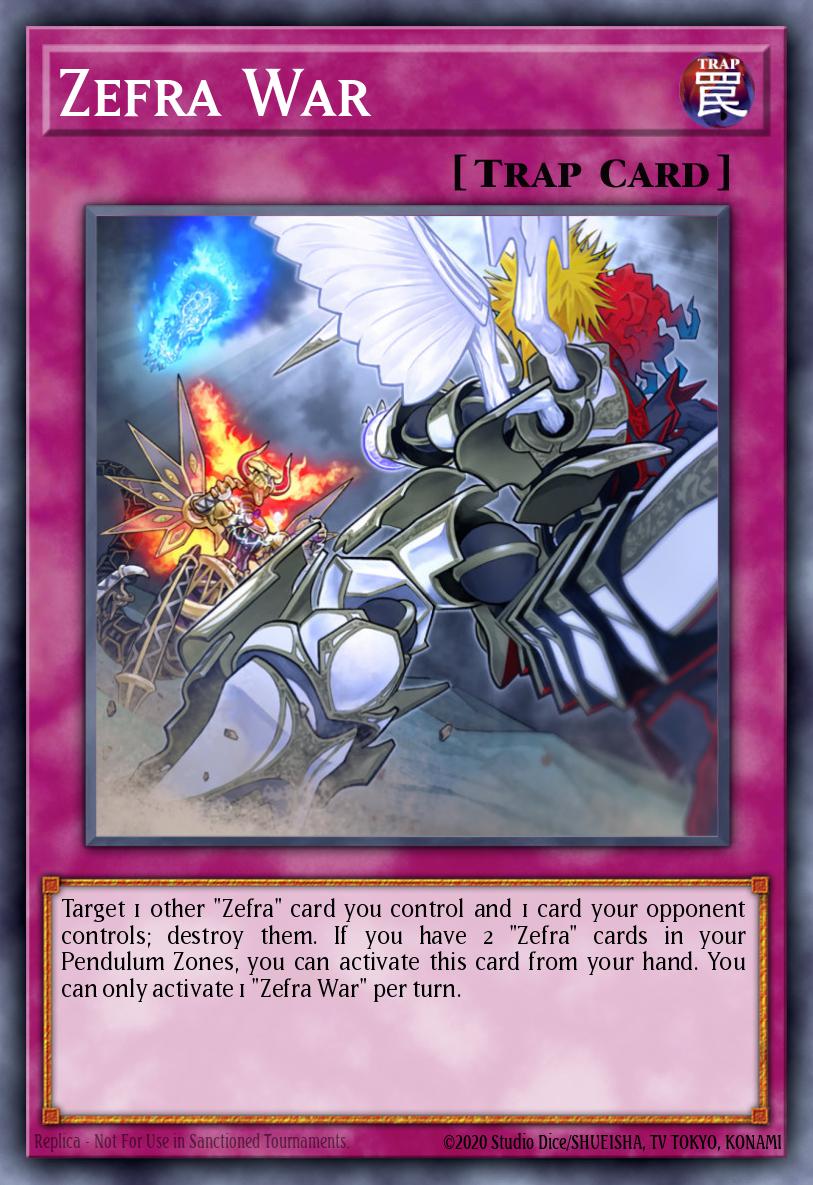
Zefra War
Archetype:
Zefra
View:
3757
Target 1 other "Zefra" card you control and 1 card your opponent controls; destroy them. If you have 2 "Zefra" cards in your Pendulum Zones, you can activate this card from your hand. You can only activate 1 "Zefra War" per turn.
Zefra War — Power Evaluation
Final Score: 58 ± 6 · Confidence: Medium
- Intrinsic: 57.5 · Deck: 58.5 · Meta: provisional
- Primary role: Removal / Negation · Secondary: Board breaker
Why it scores here
Zefra War turns one of your own Zefra cards into the destruction of one opposing card, so it is a removal trade that is roughly even at best and loses a card of yours in the exchange. Its strength is flexible, trap-speed interaction plus a hand-activation route when two Zefra sit in the Pendulum Zones, not board presence or material value. The 115-deck sample confirms it is core Zefra support (observed), but that is consistent play, not intrinsic power (guardrail 3). The score is held back by the once-per-turn limit, the Zefra-only cost, the absence of combo and guide evidence, and the lack of rulings.
Axis scores
| Axis | Score | Evidence |
|---|---|---|
| Accessibility | 60 | Usually a set trap needing a live Zefra target, with a hand-activation route when 2 Zefra are in the Pendulum Zones; the Zefra decks run Pendulum setups (verified text, observed 115 decks). Reliable within its archetype but conditional. |
| Combo & Conversion | 35 | Text describes a single 1-for-1 destruction with no board or extension; no combo boards recorded, so conversion rests on card text alone (inferred). |
| Resource Economy | 35 | Requires destroying one of your own Zefra and one opposing card, so it is an even-or-worse trade with no refuel or draw (verified text). |
| Effect & Interaction | 70 | Destroys any opposing card with once-per-turn limit and trap-speed use from hand, a strong and flexible removal profile (verified text; the no-combo evidence keeps it from scoring higher). |
| Material Utility | 5 | Trap card, so it is never Material and provides no level, attribute, or name value (verified card type). |
| Resilience & Flexibility | 45 | Set in the backrow it can be negated or destroyed, and it needs an own Zefra target, so it is vulnerable to interruption; hand activation adds some recovery (inferred from text). |
| Deck-Building Efficiency | 65 | Average 1.21 copies across 115 decks, no garnets or locks, and a single trap slot with no restriction (observed deck stats, verified card type). |
Calculation
Weight profile: 0.7 Removal / Negation + 0.3 Board breaker. Intrinsic ≈ 57.5, Deck ≈ 58.5, Meta = provisional. Modifiers: none. Final formula: 0.40*Intrinsic + 0.60*Deck
Strengths
- Flexible destruction of any opposing card at trap speed
- Hand activation with two Zefra in the Pendulum Zones adds reach
- Cheap single slot with low copy count needed (avg 1.21 per deck)
- Strong accessibility within the Zefra archetype (115 decks, 22 archetypes)
Weaknesses
- Once-per-turn limit
- Costs one of your own Zefra cards, so it is not card-advantageous
- Requires a Zefra target on your side for normal activation
- No combo, guide, or ruling evidence to confirm its conversion value
Counters / choke points
- Negation or backrow destruction of the set trap (inferred from general trap rules; no counter data in evidence)
Best use
Removal of an opposing card at the cost of one own Zefra. Decks: Zefra (archetype lists 182 and 621), Zefra Providence / Zefraniu / Zefraath shells. Suggested copies: 1.
Evidence & gaps
- Verified: Card text: destroy 1 own Zefra and 1 opposing card; hand activation with 2 Zefra in Pendulum Zones; once per turn; Card type: Trap, Normal race, no ATK or DEF
- Observed: Present in 115 of recent decks, avg 1.21 copies, 22 archetypes; Partners with Zefra Providence (94.8%) and Zefraniu (92.2%)
- Inferred: Trap-speed interaction is strong but conditional on a Zefra target; Vulnerable to backrow negation or destruction while set
- Data gaps: no combos supplied, so combo conversion is text-only inference no guides supplied no banlist token, assumed 3 copies (unlimited) no usage statistics (StatisticsCard), so archetype inclusion is inferred from deck sample only no rulings supplied